
The American Dream, at 250.
28 leaders, operators and retirees from across the country came together for one live hour to say what they really think about the American Dream: simultaneously, anonymously, in real time.

Read the full report
10 pages · charts, quotes, methodology · free, no email required.
A single hour. Every voice. Real-time consensus.
In honor of America’s 250th birthday, we asked 28 leaders, operators and retirees from across the country a simple but charged question: Is the American Dream still attainable? Participants submitted open text, ranked options, and rated statements simultaneously and anonymously. AI synthesized themes in-session and validated them back to the group before each new activity, so consensus wasn’t guessed; it was watched forming. Every chart in this report is direct participant data, not a summary of opinion.
The room: 57% Boomer, 21% Gen X, 21% Millennial. 39% Republican, 32% Democrat, 25% Independent. 64% West, balanced across South, Midwest and Northeast. 75% parents, 50% with graduate degrees.
The headline: belief in the idea held. Belief in the path didn’t.
93% of participants said the American Dream still matters. 70% said they’re more pessimistic about it now than they were a decade ago. The idea endures; the path people once trusted to get there does not.
That gap is the whole story of this session. Belief in the dream as a moral and civic ideal is intact across generations. Belief that today’s institutions, today’s economy, and today’s politics will deliver it is collapsing, fastest among the people who are supposed to be living it now.
That tension is the whole story.
The dream was always a myth. It’s just been more fully exposed.
The generational cliff
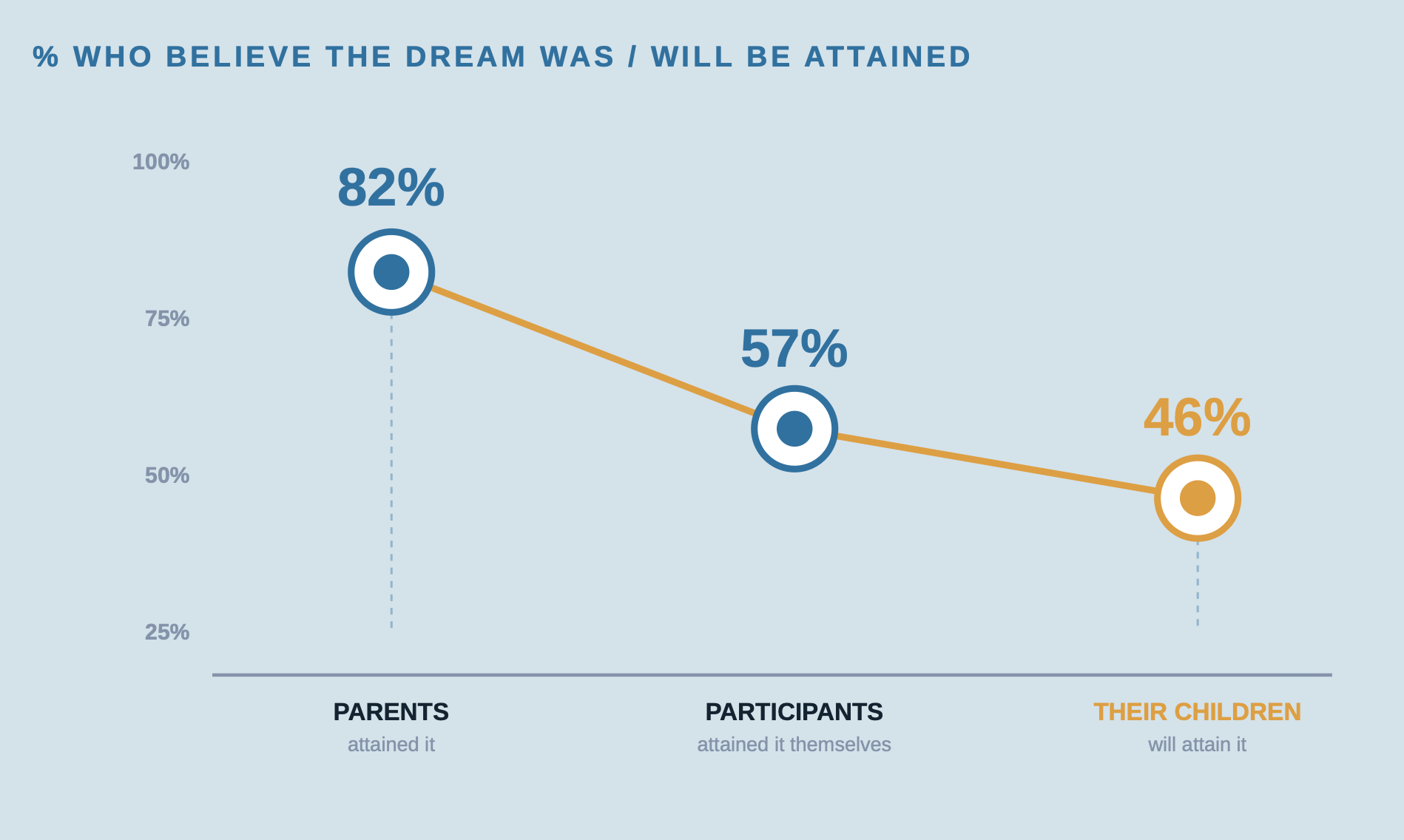
Belief that the American Dream is achievable for the next generation didn’t decline gradually across cohorts. It fell off a cliff. 82% of participants said their parents attained the Dream. 57% said they’ve attained it themselves. Only 46% believe their children will. A 36-point drop in a single generation.
The most-used response on the children question wasn’t “no.” It was “not sure.” Of 28 participants, only 3 said “no” outright; 12 chose “not sure.” That’s the middle ground where anxiety lives.
Avg age of a first-time home buyer is now closer to 40. Avg house is about 500k or more. Plus childcare is 1000+/month. Most people simply cannot afford the house and kids.
The picket fence is out. Flexibility is in. Nobody’s sure it’s an upgrade.
We asked participants to describe the traditional Dream and the new Dream in their own words, then to rate the shift. The words they used tell the story better than any chart.
Own it. Keep it. Pass it down.
- Homeownership, suburbs, white picket fence
- Financial security & early retirement
- A good pension from a career employer
- Ability to start & own a business
- Rising standard of living each generation
- Freedom of religion & personal liberty
- Passing wealth on to children
Stay flexible. Find meaning. Survive the costs.
- Flexibility, agility, remote work
- Work-life balance over career climbing
- Purposeful, impactful work
- Experiences, travel, mobility over stuff
- Health, wellness, mental space
- Individuality & the freedom to define “family”
- Getting out from under education debt
But the new Dream isn’t winning hearts. “Home ownership is increasingly out of reach” was the single most-agreed statement of the session at 4.62/5. 50% of the room said it’s “too early to tell” whether the new Dream is a good change. Only 12% called it good. 38% called it bad outright, nearly four times as many.
People still believe in people. They don’t believe in the systems.
When we asked participants to rank what enables the American Dream, the top answers were personal: drive, innovation, hope, hard work. When we asked what constrains it, the top answers were structural: political dysfunction, debt, healthcare, housing.
The locus of control split is striking. Personal traits go in the “yes, I can act on this” column. Institutions go in the “no, this is happening to me” column. 52% of the room said the constrainers outweigh the enablers. Only 33% said the reverse. People have not given up on themselves. They have given up on the systems around them.
The cruel gap
We asked participants to rate twelve potential changes (from “make childcare affordable” to “fix campaign finance” to “rebuild civics education”) on two dimensions: how much impact would this have, and how feasible is it by 2030?
Every one of the twelve scored higher on impact than on feasibility. Every one. Five of the six highest-impact levers (cost of living, healthcare reform, political reform, reducing polarization, and fiscal/tax reform) all clustered in the same place on the chart: high impact, low feasibility. The cruel gap.
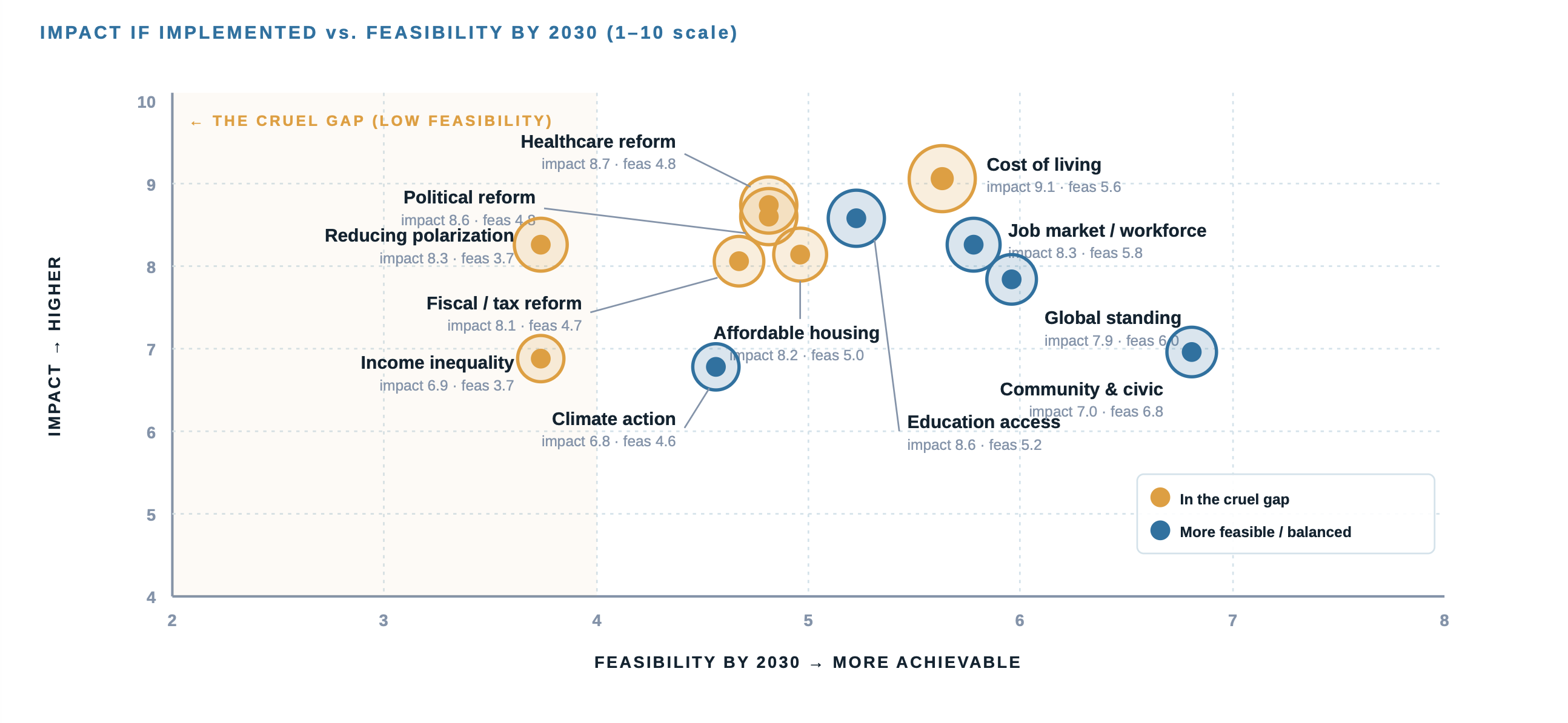
This is what hopelessness looks like in data. It is not “we don’t know what to do.” It is “we know what to do and we don’t believe we will do it.”
Cautious for the country, joyous at home
56% of participants said most Americans will be cautious about the country’s 250th. 44% said they personally will be joyous. People are almost twice as joyous about the milestone in their own household as they expect their fellow Americans to be. 63% of respondents said Gen Z will be less inspired by the 250th than they were five years ago, the largest delta of any cohort.
The pattern across the data: people are protecting the part of the dream they can still touch, and quietly mourning the part they can’t.
The post-Trump era could be used to course correct, strengthen our institutions, and safeguard our political system. It should be a time to refocus on what the American Dream is.
Voices from the room
Participants responded anonymously throughout the session: no names, no cameras, no social pressure. What follows is a slice of the open-text responses we collected.
While we want to believe we are still the best country, research is clearly demonstrating the story we want to tell ourselves and the real story being told shows we are losing sight of the dream.
It seems harder for people to tap into unless they have the benefits of education and access to money to get started. There are exceptions but these seem to be rarer. We seem to have a shrinking middle class.
Feedback was much better than in mainstream news or social media. It has been encouraging to have discourse with real people of diverse backgrounds and to see what we have in common. We all want good lives.